



The Anatomy of a BC Concrete Subfloor
Whether you live in a brand-new high-rise in Brentwood, a 1980s concrete low-rise in New Westminster, or a detached home with a basement suite in Coquitlam, your hard flooring will likely be installed over a concrete slab.
Many homeowners assume that because concrete is hard and poured by professionals, it is naturally flat. This is a massive misconception.
Concrete is a mixture of water, cement, and aggregates. As it cures, it shrinks. The rate of drying, the temperature on the day it was poured, and the settling of the building's foundation over decades all contribute to the final shape of the slab. In Greater Vancouver, seismic settling and high water tables further exacerbate these imperfections.
The result? A concrete slab that looks flat to the naked eye but is actually a landscape of rolling hills (high spots) and shallow valleys (low spots).
"Level" vs. "Flat": Understanding the Flooring Industry Standard
Before we dive into the consequences of a bad subfloor, we must clarify two terms that are often confused: Level and Flat.
Level: This means the floor is perfectly horizontal relative to gravity (like water in a glass). A floor does not necessarily need to be perfectly level. Many older homes have a slight slope, which is fine as long as the slope is smooth.
Flat: This means there are no bumps, dips, or waves on the surface. Flooring requires a FLAT subfloor.
The 3/16-Inch Rule
Every major flooring manufacturer in the world (whether for laminate, hardwood, or LVP) has a strict tolerance for flatness. The universal industry standard states that a subfloor must be flat to within 3/16 of an inch over a 10-foot radius (or 1/8 of an inch over a 6-foot radius).
If your concrete slab has a dip deeper than 3/16 of an inch, and you lay a rigid plank over it, you are creating a microscopic bridge. When you step on that "bridge," the plank bends.
The 4 Nightmare Scenarios of Skipping Subfloor Leveling
Why do some generic contractors skip this step? Because proper concrete grinding and self-leveling require expensive equipment, highly specialized knowledge, and extra days of labor. However, skipping this crucial step leads to four expensive consequences:
1. Broken Locking Mechanisms (The LVP & Laminate Killer)
Modern Luxury Vinyl Plank and Laminate floors use a "click-lock" system. The tongue-and-groove joints are precision-milled to lock together tightly, creating a seamless, water-resistant surface. If a plank is suspended over a low spot in the concrete, your body weight forces the plank to bend downward. This puts immense stress on the millimeter-thin click joints. Over time, this constant bending will literally snap the locking mechanisms. The planks will separate, leaving ugly, dirt-catching gaps that cannot be pushed back together.
2. Squeaks, Pops, and Hollow Echoes (The Acoustic Nightmare)
As discussed in our Vancouver Strata Acoustic Guide, sound transmission is a massive issue in multi-family buildings. If there is a void between your acoustic underlayment and the concrete subfloor, that pocket of air acts like a drum. Every footstep will resonate, creating a loud, hollow clapping sound. In severe cases, the friction of the planks rubbing together causes loud squeaks. Your downstairs neighbors will complain, and your strata council may get involved.
3. "Telegraphing" (Visual Imperfections)
Luxury Vinyl Plank (particularly thinner, flexible variants) will eventually mold itself to the shape of the floor beneath it. If you have a sharp ridge or a raised crack in your concrete, that imperfection will eventually push through and become visible on the surface of your beautiful new floor. This phenomenon is called "telegraphing," and it ruins the sleek, high-end look of your home.
4. Completely Voided Manufacturer Warranties
This is the hardest lesson for homeowners to learn. If you spend $8,000 on premium flooring and it begins to separate or crack, you will naturally call the manufacturer to file a warranty claim. The very first thing the manufacturer’s inspector will do is pull up a plank and check the subfloor with a straightedge. If they find the concrete was not leveled to the 3/16-inch standard, your 25-year warranty is instantly voided. The manufacturer takes zero responsibility for floors installed over improper subfloors.
The Elite Flooring Subfloor Preparation Process
At Elite Flooring Ltd., we refuse to compromise on quality. We know that the longevity of your floor is 100% dependent on what lies beneath it. Here is our rigorous, professional process for preparing concrete subfloors in BC homes:
Step 1: The Laser and Straightedge Assessment
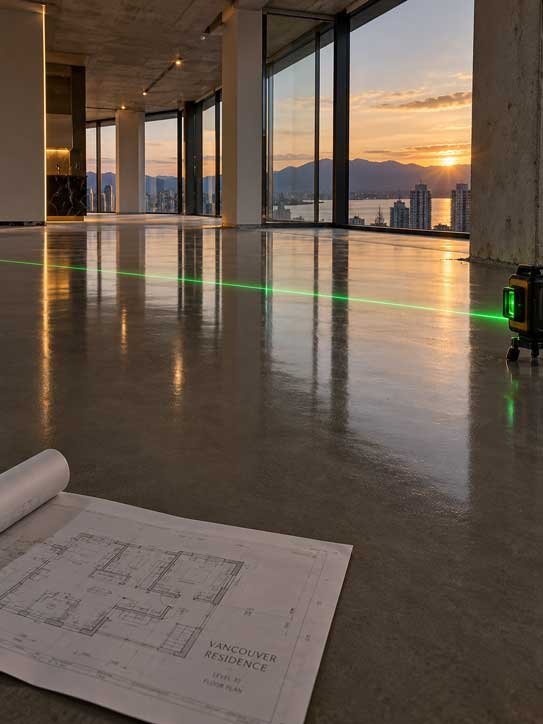
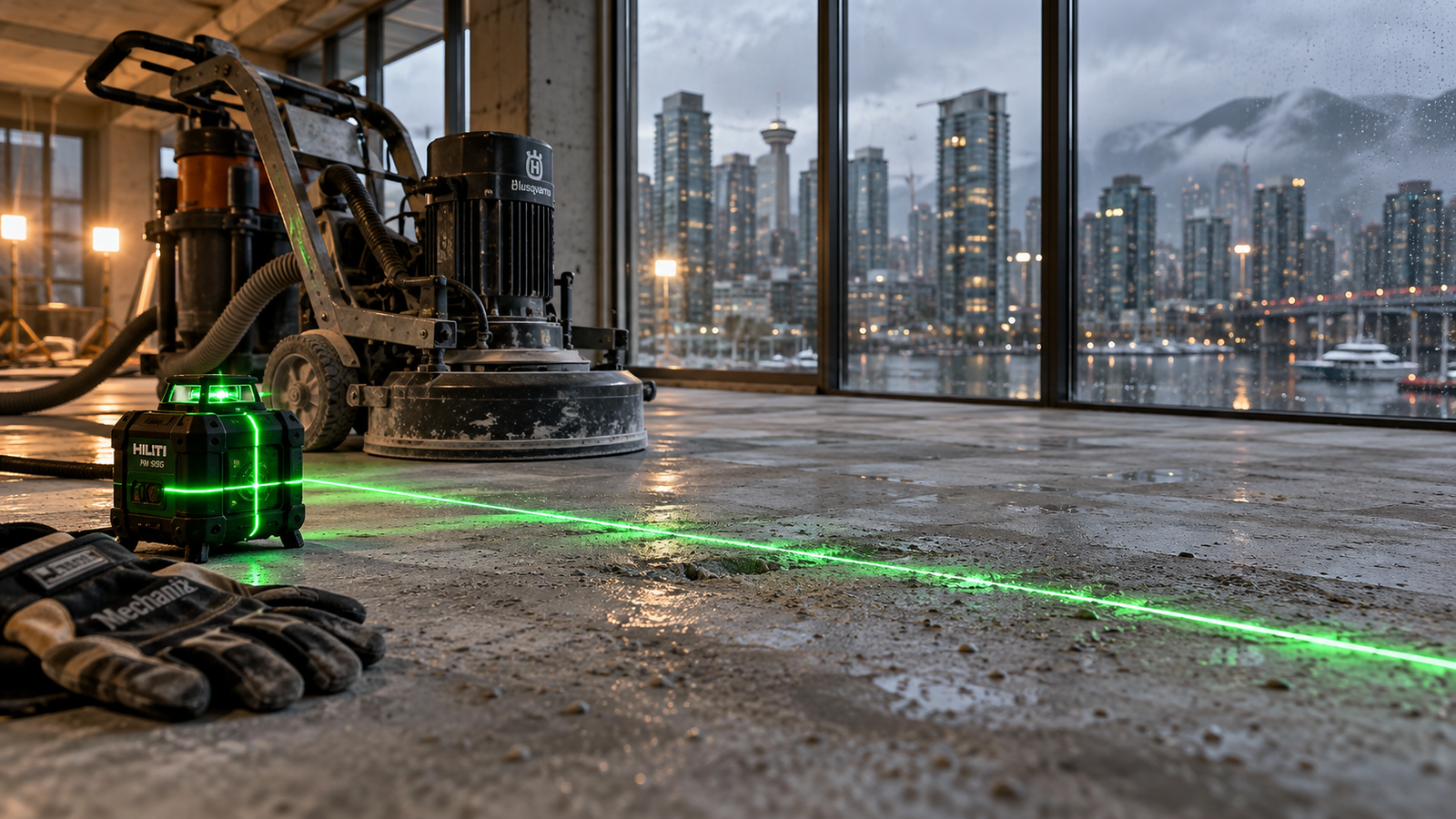
We never guess. During our initial site preparation, we sweep the raw concrete completely clean. We then use a combination of 10-foot aluminum straightedges and high-tech 360-degree laser levels to map the topography of your room. We mark every high spot with a circle and every low spot with an "X."
Step 2: Concrete Grinding (Tackling the High Spots)
You cannot fill a floor to match a mountain; you must bring the mountain down. We use heavy-duty planetary concrete grinders equipped with diamond-segmented blades to shave down raised concrete seams, high ridges, and old adhesive bumps. Note on cleanliness: We pair our grinders with industrial HEPA-filter vacuums. This ensures that the highly toxic silica dust generated by grinding concrete is captured immediately, keeping your home’s air quality safe and clean.
Step 3: Surface Priming
Self-leveling compounds will not stick to dusty or overly porous concrete. We apply a premium, deeply penetrating acrylic primer to the entire concrete slab. This seals the pores of the concrete, prevents moisture from being sucked out of the leveling compound too quickly, and ensures a permanent chemical bond.
Step 4: Pouring the Self-Leveling Underlayment (SLU)
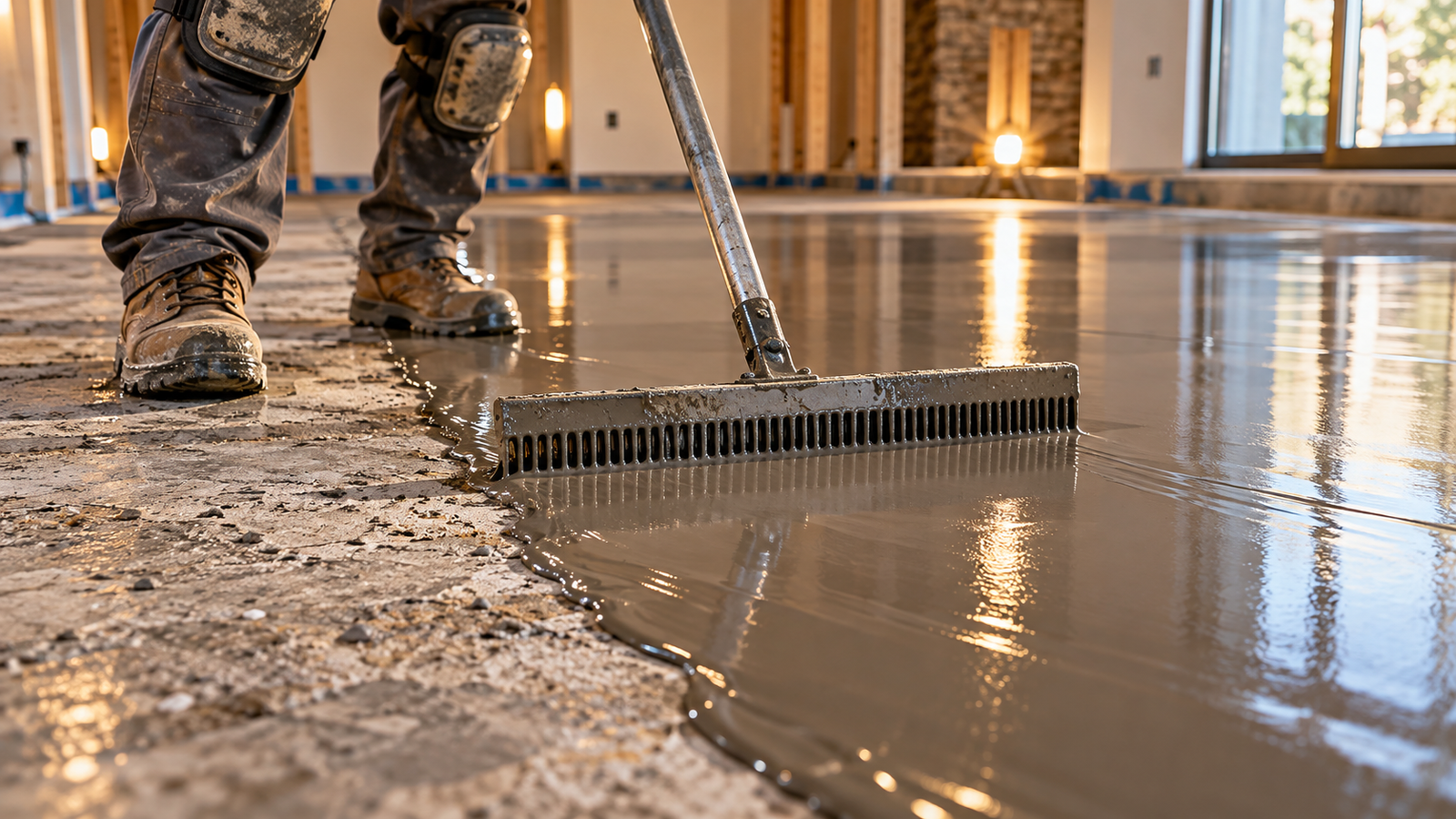
For the low valleys, we use polymer-modified Self-Leveling Underlayment (SLU). This is not regular concrete. It is a highly engineered, flowable liquid cement that seeks its own level (like water) before rapidly hardening. We mix the SLU to exact manufacturer specifications, pour it into the low zones, and use specialized gauge rakes and smoothing smoothers to feather the edges perfectly into the surrounding concrete. Within a few hours, the compound cures into a rock-hard, perfectly flat surface.
Step 5: Moisture Testing and Mitigation
Because Vancouver experiences significant rainfall, ground-level and basement concrete slabs absorb moisture from the earth. Before laying any flooring, we test the slab's moisture emission. If the moisture levels are too high, we apply a 100% waterproof epoxy moisture barrier over the leveled concrete, ensuring ground dampness never reaches your new hardwood or laminate.
The Cost of Leveling vs. The Cost of Failure
One of the most common questions we get during our free estimates is: "How much does subfloor leveling add to the total cost?"
The cost of concrete preparation depends entirely on the condition of your slab. On average, in Greater Vancouver, minor grinding and patching might add $1.50 to $2.50 per square foot. Extensive self-leveling pours (for severely uneven basement slabs) might range from $3.00 to $4.50+ per square foot, accounting for the expensive polymer materials and specialized labor.
Think of this not as an extra cost, but as an essential insurance policy.
If you save $2,000 by skipping subfloor preparation, you are virtually guaranteeing that your $15,000 flooring investment will fail within 12 to 24 months. You will then have to pay to rip up the ruined floor, buy all-new materials, pay for the leveling you skipped the first time, and pay for a second installation.
Doing it right the first time is always the most economical choice.
Why General Contractors Often Struggle with Subfloors
Many excellent general contractors (GCs) and handyman services operate in Vancouver. However, flooring is a highly specialized trade.
A general contractor who installs drywall on Monday and fixes plumbing on Tuesday rarely owns a $3,000 dustless concrete grinder or stocks the rapid-curing, specialized self-leveling compounds required for a flawless finish. They often try to fix low spots with cheap, hardware-store floor patch, which simply crumbles to dust under the heavy traffic of a living room.
By hiring a dedicated flooring specialist like Elite Flooring Ltd., you ensure that the technicians handling your subfloor have the specific training, industrial equipment, and deep understanding of manufacturer warranties required to build an indestructible foundation.
Ready for a Flawless Flooring Installation?
The secret to a stunning, silent, and long-lasting floor isn't just the brand of wood or vinyl you choose—it is the meticulous, invisible engineering that happens before the first plank is ever laid.
Don't let a bad concrete slab ruin your Vancouver home renovation. At Elite Flooring Ltd., our obsession with perfect subfloor preparation guarantees that your new floors will feel as solid, luxurious, and beautiful on day 10,000 as they do on day one.
[Contact Elite Flooring Ltd. today to schedule your free, on-site laser subfloor assessment and estimate!]
