
At a Glance: Average Hardwood Flooring Costs in Vancouver (2026)
Most homeowners in Metro Vancouver spend between $11.00 and $24.00 per square foot for a complete hardwood flooring project, encompassing high-quality materials, professional subfloor preparation, and skilled installation.
Here is a quick snapshot based on common residential project sizes across the Lower Mainland:
| Project Scope / Room Size | Square Footage | Estimated Total Cost (Materials + Labor + Basic Prep) |
| Condo Living Room / Master Bedroom | 300 – 400 sq. ft. | $3,600 – $8,800 |
| Typical Vancouver Apartment / Suite | 700 – 900 sq. ft. | $8,400 – $19,800 |
| Single-Family Main Floor (Living, Dining, Hallway) | 1,200 – 1,500 sq. ft. | $14,400 – $33,000 |
| Full Two-Story Home (Detached House) | 2,200 – 2,800 sq. ft. | $26,400 – $61,600 |
To see how these numbers come together, let's look at the primary components: material costs and labor.
1. Material Costs: Solid Hardwood vs. Engineered Hardwood
Hardwood broadly splits into two categories, each with distinct pricing and performance characteristics tailored to Pacific Northwest climates.
+-------------------------------------------------------------------------+
|                        Solid vs. Engineered Anatomy                     |
|                                                                         |
|  SOLID HARDWOOD:                                                        |
|  [ Pure Natural Wood Plank (100% Single Timber Species) ]               |
|                                                                         |
|  ENGINEERED HARDWOOD:                                                   |
|  [ Real Wood Top Veneer (e.g., 3mm - 6mm European Oak) ]                |
|  [ Multi-ply Plywood / HDF Cross-Grain Core (Moisture Resistant) ]     |
+-------------------------------------------------------------------------+
Engineered Hardwood ($6.00 – $16.00+ per sq. ft. for materials)
Engineered hardwood features a genuine hardwood veneer (such as White Oak, Walnut, or Maple) permanently bonded over multiple cross-laid core layers of birch or spruce plywood.
Why it dominates Vancouver: Because wood expands and contracts with humidity, solid wood often struggles during damp coastal winters. Engineered hardwood provides maximum dimensional stability against shifting atmospheric moisture.
Cost range: Standard 5-inch planks with a 2mm to 3mm wear layer start around $6.00 to $8.50/sq. ft. Wide-plank European Oak (7.5 to 9.5 inches wide) with a thick 4mm to 6mm sandable wear layer runs $10.00 to $16.00+/sq. ft.
Solid Hardwood ($8.00 – $18.00+ per sq. ft. for materials)
Solid hardwood is milled from a single, continuous piece of timber, typically 3/4-inch thick.
Best applications: Above-ground levels of detached homes with stable indoor humidity control systems.
Cost range: Domestic species like Canadian Hard Maple, Red Oak, or Ash range from $8.00 to $12.00/sq. ft. Exotic timbers (such as Brazilian Cherry or Teak) or custom wire-brushed finishes can reach $15.00 to $20.00/sq. ft.
2. Professional Installation & Labor Rates
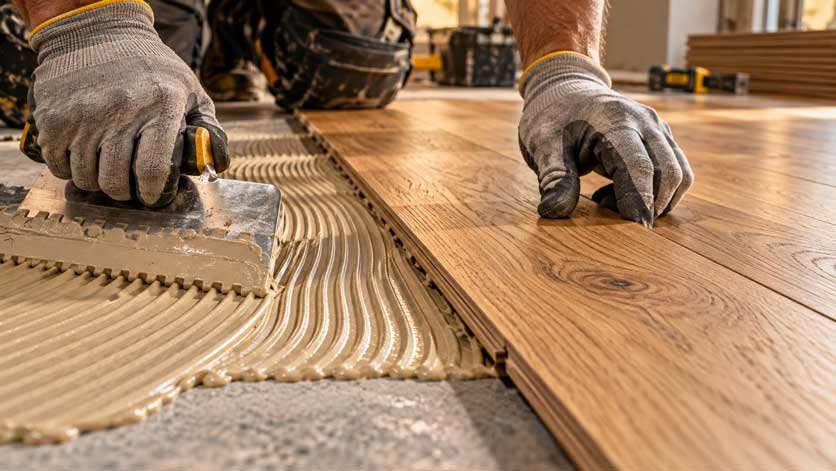
In Greater Vancouver, certified flooring installers charge either an hourly rate or, more commonly, a flat rate per square foot based on the installation method required.
+-----------------------------------------------------------------------+
|                 Primary Hardwood Installation Methods                 |
|                                                                       |
|   1. Floating Click/Lock:   $3.50 – $5.00 / sq. ft.                   |
|   2. Nail-Down (Cleats):    $4.50 – $6.50 / sq. ft.                   |
|   3. Direct Glue-Down:      $5.50 – $8.00 / sq. ft.                   |
+-----------------------------------------------------------------------+
A. Floating Floor Method ($3.50 – $5.00 per sq. ft.)
Planks click together or are glued at the tongue-and-groove joint over an approved acoustic underlayment, without anchoring into the subfloor.
Pros: Fastest and most cost-effective method; ideal for high-rise concrete slabs.
Cons: Has a slightly lighter feel underfoot compared to glued or nailed floors.
B. Nail-Down / Staple-Down Method ($4.50 – $6.50 per sq. ft.)
Planks are fastened directly into an existing plywood or OSB subfloor using flooring cleats or staples.
Pros: Exceptionally solid, zero shifting, long-term durability.
Cons: Can only be used over wooden subfloors (standard in detached single-family homes and townhomes), not over concrete slabs.
C. Direct Glue-Down Method ($5.50 – $8.00 per sq. ft.)
Planks are permanently bonded to the subfloor using specialized elastomeric adhesives.
Pros: Delivers a permanent, substantial feel underfoot, eliminates hollow echo sounds, and enhances sound dampening in luxury properties.
Cons: Requires higher labor time and expensive commercial-grade acoustic adhesive ($150 to $250 per pail, covering roughly 150 to 200 square feet).
3. The Crucial Extras: Site Preparation & Hidden Costs
Many budget calculations derail because they only factor in the cost of the boards and the act of laying them. In real-world Vancouver renovations, existing site conditions dictate final expenses.
Subfloor Leveling & Concrete Grinding ($1.50 – $4.50 per sq. ft.)
This is the single most critical step in high-end flooring installation. Hardwood requires a flat subfloor with a tolerance of 3/16 inch over a 10-foot radius (or 1/8 inch over 6 feet).
If your subfloor has humps, installers must grind down the concrete or sand the wood joists.
If your subfloor has valleys, high-grade polymer-modified self-leveling underlayment must be poured.
Skipping this step causes squeaking, bouncy boards, and broken locking joints.
Demolition & Old Flooring Disposal ($1.50 – $3.50 per sq. ft.)
Removing existing materials requires time and disposal fees at local recycling depots:
Carpet & Underpad Removal: $1.00 – $1.50 per sq. ft.
Floating Laminate/Vinyl: $1.25 – $1.75 per sq. ft.
Glued Hardwood or Ceramic Tile Removal: $2.50 – $4.00+ per sq. ft. (Tile demolition is labor-intensive and requires mechanical chipping hammers).
Acoustic Underlayment ($0.65 – $2.00 per sq. ft.)
Essential for condominiums subject to Strata council bylaws. Premium recycled rubber or high-density cork underlayments meeting an IIC 72 sound rating typically cost between $1.20 and $1.85 per square foot.
Baseboards, Shoe Molding & Transitions
Baseboard Removal & Reinstallation: $2.00 – $3.50 per linear foot.
Supply and Installation of New Modern Baseboards: $4.00 – $7.50 per linear foot (painted and caulked).
Doorway Reducers, T-Moldings & Flush Stair Nosings: $40 – $90 per transition piece.
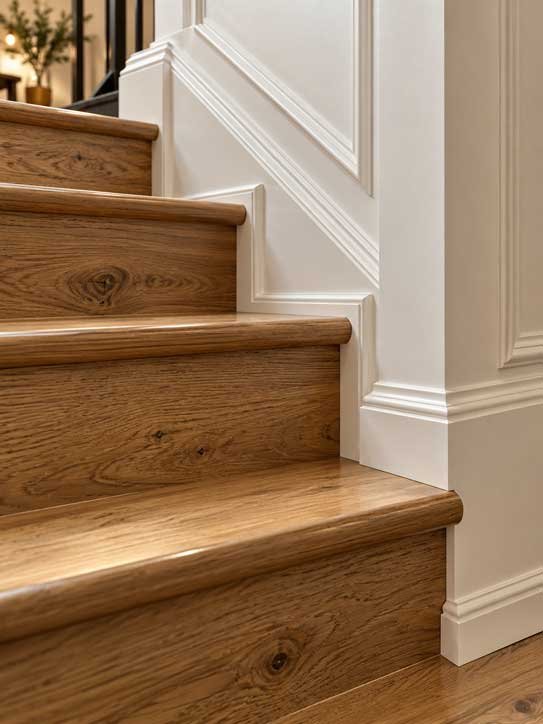
Staircases: Installing hardwood on stairs requires detailed carpentry. Expect $120 to $200 per step (tread and riser), including flush bullnose integration.
What Drives Costs Up or Down in Greater Vancouver?
Beyond materials and square footage, specific regional conditions influence project estimates:
Building Access & Parking Regulations: Installing in a detached home in Coquitlam with a flat driveway is logistically straightforward. Working on the 28th floor of a downtown Vancouver high-rise requires booking elevator times, hauling heavy planks up service lifts, paying street parking meter rates, and strict working hours (often limited to 9:00 AM – 4:30 PM). These logistics reflect in labor estimates.
Moisture Barriers in Coastal Ground Levels: Lower Mainland homes in areas with high water tables (such as Richmond or South Delta) require heavy-duty moisture mitigation coatings over concrete slabs before hardwood can be installed safely.
Room Geometry & Complex Layouts: Open-concept layouts are fast and cost-effective to floor. Intricate floor plans with curved walls, angled hallways, custom fireplace hearths, and walk-in closets require meticulous scribing, custom cuts, and increased material waste allowances (calculating 10% to 15% extra material instead of the standard 7% to 10%).
5 Practical Strategies to Save on Hardwood Installation
You don't need to sacrifice quality to keep your renovation budget under control. Here are smart strategies to optimize your investment:
Handle the Easy Demolition Yourself: Tearing out old carpet and pulling up tack strips requires minimal tools, just time and effort. Removing carpet yourself can save $800 to $1,500 on an average home.
Move Your Own Furniture: Contractors bill for time spent clearing rooms, packing knick-knacks, and disconnecting appliances. Moving furniture out of the work zone before installers arrive cuts labor hours directly.
Choose Standard Plank Widths: While ultra-wide 9.5-inch European oak planks look stunning, premium 5-inch to 7-inch planks offer virtually identical longevity and aesthetic warmth at 20% to 35% lower material costs.
Order the Correct Waste Overage: Ordering too little wood leads to work delays, mismatched dye lots, and emergency freight fees. Ordering too much wastes capital. Aim for 7% to 10% waste for simple rectangular layouts, and 12% for intricate or diagonal layouts.
Never Compromise on Subfloor Prep: Spending money on leveling may feel like an invisible cost, but it protects your flooring warranty. An uneven subfloor can ruin a $15,000 floor within two years, turning early savings into expensive repairs.
Realistic Sample Project Estimates
To visualize how all these factors come together, review these typical project budgets handled by Elite Flooring Ltd.:
Scenario A: The Yaletown Condo (750 sq. ft.)
Material: 7.5-inch Engineered White Oak ($9.00/sq. ft.) = $6,750
Underlayment: IIC-rated 3mm Acoustic Rubber ($1.40/sq. ft.) = $1,050
Labor: Floating Click Installation ($4.00/sq. ft.) = $3,000
Prep & Details: Minor concrete grinding + 6 transitions + new baseboards = $1,600
Old Carpet Demolition & Disposal: $1,000
Total Estimated Investment: $13,400 (approx. $17.85/sq. ft. all-inclusive)
Scenario B: The Burnaby Single-Family Home (1,400 sq. ft.)
Material: 5-inch Wire-Brushed Engineered Oak ($7.50/sq. ft.) = $10,500
Labor: Direct Glue-Down over Plywood Subfloor ($6.00/sq. ft.) = $8,400
Adhesive: Low-VOC Sound & Moisture Urethane Glue = $1,800
Prep & Details: Plywood sanding, flush transitions, 220 linear ft. baseboards = $2,400
Total Estimated Investment: $23,100 (approx. $16.50/sq. ft. all-inclusive)
Get a Transparent, Accurate Estimate for Your Space
Every home across Greater Vancouver is distinct. Whether you're working with an aging subfloor in a North Vancouver heritage home or complying with strict acoustic regulations in a Coal Harbour high-rise, generic ballpark estimates only tell part of the story.
At Elite Flooring Ltd., we eliminate guesswork with our comprehensive on-site consultations:
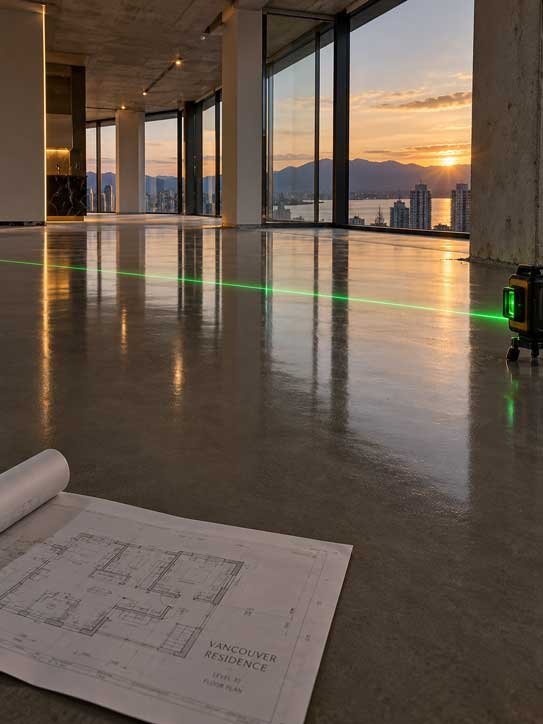
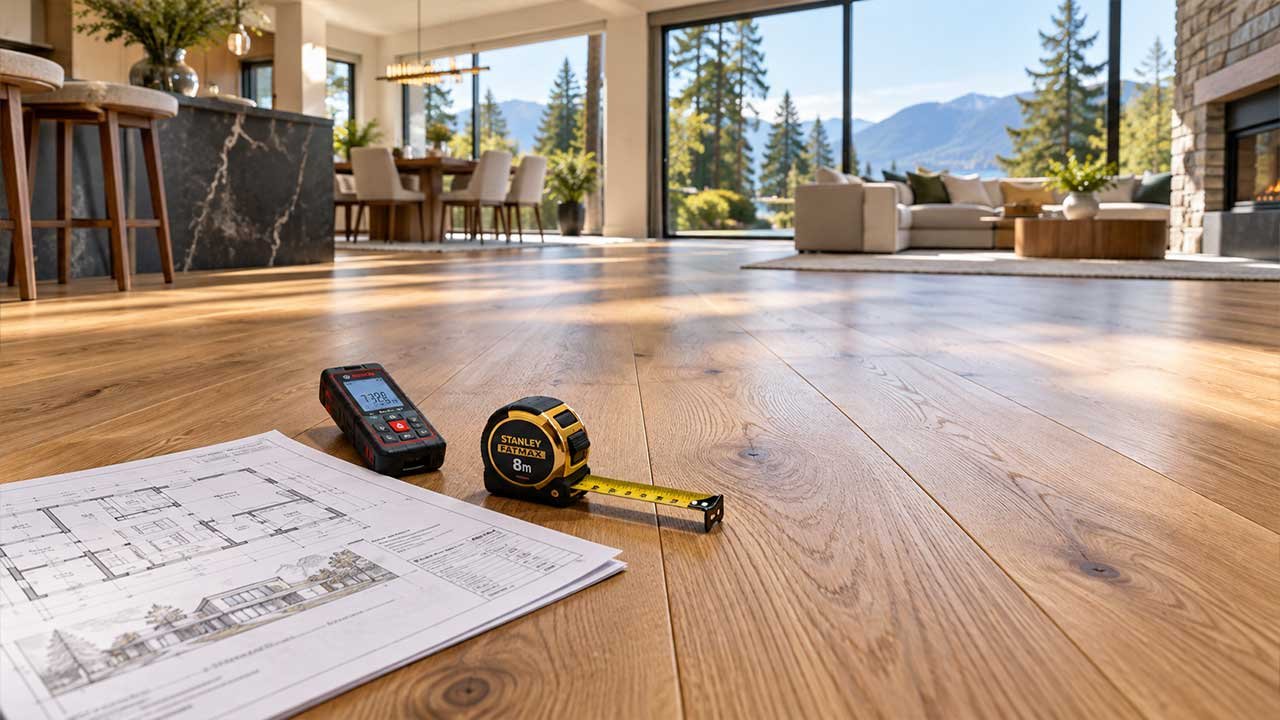
Precise laser measurements of your exact square footage.
Detailed subfloor moisture and levelness inspections.
Clear, itemized proposals detailing materials, prep work, and labor with zero hidden surprises.
Comprehensive 1-Year Workmanship Warranty alongside manufacturer warranties.
Transform your living spaces with confidence, craftsmanship, and lasting value.
[Contact Elite Flooring Ltd. today to schedule your complimentary on-site consultation and laser measurement!]
