


Why Are Strata Councils So Strict About Flooring?
To understand the rules, you must understand the architecture of Greater Vancouver.
Our region features two main types of multi-family buildings:
Wood-Frame Buildings: Common in low-rise condos (4 to 6 stories) built across the Lower Mainland. Wood transfers sound incredibly easily. When a rigid floor (like hardwood or laminate) is placed directly on a wood subfloor, it creates a percussion effect.
Concrete High-Rises: Dominating Downtown Vancouver and Brentwood, concrete slabs are better at stopping airborne noise (like voices) but are notoriously bad at stopping impact noise. Striking a concrete slab sends shockwaves straight through the rebar and into the neighbor's ceiling.
When a builder originally installs carpet, the thick padding naturally absorbs these impacts. When you replace that carpet with hard flooring, you are removing the building's primary sound shock-absorber. Strata councils implement strict bylaws to ensure that the new hard surface—combined with a high-quality acoustic underlayment—mimics the sound-dampening qualities of the original carpet.
Acoustics 101: Decoding IIC, STC, and Delta Ratings
When you read your strata bylaws, you will likely encounter an alphabet soup of acronyms. Understanding these three terms is the absolute key to passing your strata application.
1. STC (Sound Transmission Class)
STC measures airborne noise. This includes voices, music, television dialogue, and dogs barking.
Fact: Your flooring underlayment actually does very little to improve STC. Airborne noise is primarily blocked by the mass of the building’s structure (the thickness of the concrete slab or the insulation in the ceiling joists). However, strata councils still often require a minimum STC rating on your underlayment spec sheet.
2. IIC (Impact Insulation Class)
IIC measures structure-borne impact noise. This includes footsteps, dropped toys, scraping chairs, and jumping.
Fact: This is the most critical metric for flooring. The higher the IIC number, the better the underlayment is at absorbing shock. Most strata councils in Metro Vancouver require an IIC rating of at least 72.
3. FIIC (Field Impact Insulation Class) & AIIC
You might see IIC and FIIC used interchangeably, but they are very different.
IIC is tested in a perfect, highly controlled laboratory environment.
FIIC (or AIIC - Apparent Impact Insulation Class) is the rating achieved when tested in a real building with real-world flanking noise (sound traveling down walls or pipes). A lab rating of IIC 72 often translates to an FIIC of around 55 in the real world. Ensure you know whether your strata is asking for a Lab rating or a Field rating.
4. Delta IIC ($\Delta$ IIC)
In 2026, progressive strata councils and property management companies are getting smarter. They know that flooring manufacturers often cheat their IIC numbers by testing their underlayment on an unrealistic 8-inch concrete slab with a drop ceiling.
Delta IIC measures only the performance of the underlayment itself, removing the concrete slab from the equation. A Delta IIC of 21 or higher is considered excellent. If your strata asks for a Delta rating, they are using the most modern acoustic standards.
The Best Types of Acoustic Underlayment for Vancouver Condos
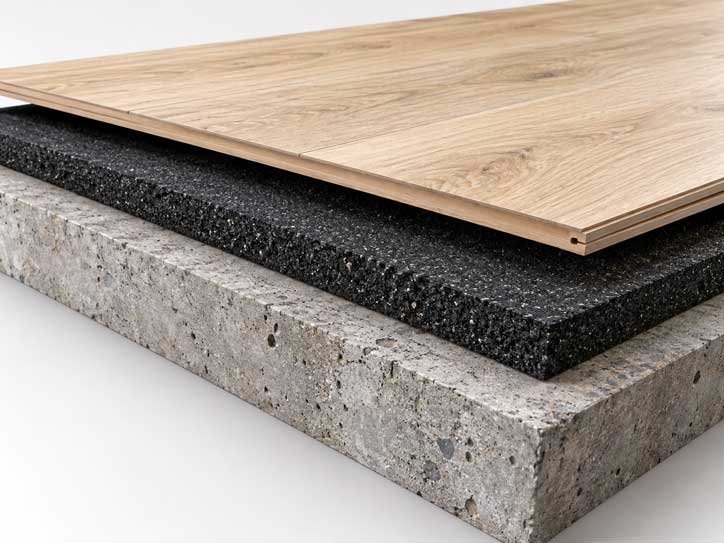
Not all underlayments are created equal. Buying a cheap, generic foam roll from a big-box store will almost guarantee a rejection letter from your strata. Here are the professional-grade options we use at Elite Flooring:
1. Premium Recycled Rubber Underlayment
Best for: Concrete high-rises, heavy engineered hardwood, and maximum sound deadening.
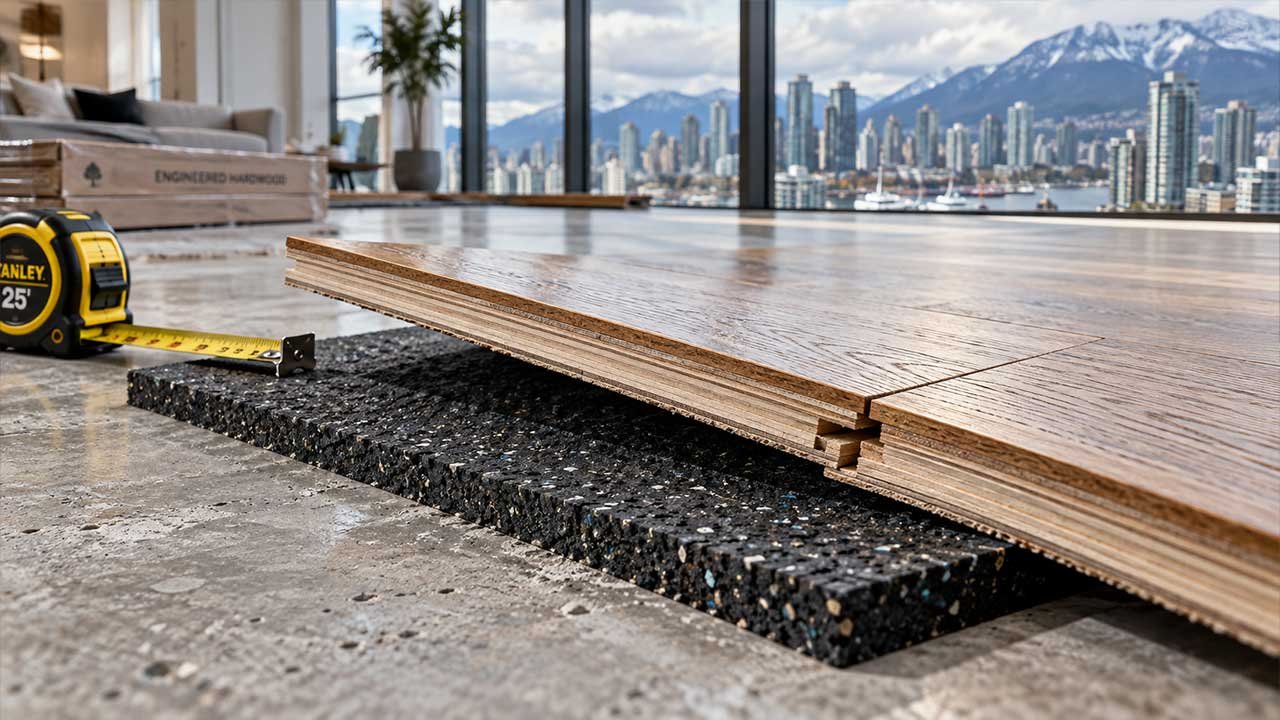
Pros: Rubber is dense, heavy, and does not compress over time. It provides exceptional IIC ratings and lasts for decades. It is the gold standard for Vancouver strata approvals.
Cons: It is more expensive and thicker (usually 3mm to 6mm), which might require door trimmings.
2. Natural Cork Underlayment
Best for: Eco-conscious homeowners and wood-frame buildings.
Pros: Cork is sustainable, naturally antimicrobial, and offers great acoustic properties. It also provides a thermal break, making the floor feel slightly warmer over unheated concrete.
Cons: Cork can crumble if exposed to severe moisture and requires a separate 6-mil poly moisture barrier if installed over a concrete slab.
3. High-Density Acoustic Foam (Advanced Polymers)
Best for: Laminate flooring and tighter budgets.
Pros: Modern closed-cell foam underlayments have evolved. Premium versions (do not confuse these with cheap, white, airy foam) offer excellent sound reduction and often come with a built-in moisture barrier.
Cons: Over many years of heavy foot traffic, some foams can compress and lose their acoustic value, leading to joint failure in click-flooring.
4. Pre-Attached Underlayment (Found on LVP)
Best for: Fast installations of Luxury Vinyl Plank.
The Trap: Many LVP products come with a 1mm or 1.5mm EVA/IXPE pad attached to the back. Warning: This pre-attached pad rarely meets strict Vancouver strata requirements on its own. You may need to add an additional specialized LVP acoustic underlayment, but you must be careful—if the secondary underlayment is too soft, the LVP joints will flex and break. Always consult an expert.
Matching the Underlayment to Your Flooring Choice
It is a common misconception that you can just buy the thickest rubber underlayment and throw any floor on top of it. The underlayment must be structurally compatible with the flooring material.
For Engineered Hardwood: You need a dense, stable base. A 3mm or 5mm rubber underlayment or a high-quality 6mm cork is ideal. It provides the necessary acoustic dampening without allowing the wood planks to bounce.
For Laminate: Laminate needs to "float" freely. A 3mm high-density acoustic foam with an integrated vapor barrier is usually the perfect balance of cost, sound dampening, and structural support.
For Luxury Vinyl Plank (LVP): LVP is thin and its click-lock joints are delicate. If you put LVP over a thick, squishy underlayment, the floor will flex when you step on it, and the locking mechanism will snap. You must use a highly specialized, ultra-dense LVP acoustic underlayment (usually no thicker than 1.5mm) that is specifically rated for high IIC performance without sacrificing rigidity.
The Elite Flooring Step-By-Step Strata Approval Guide
We have helped hundreds of clients get their flooring projects approved without stress. Here is the exact roadmap you should follow:
Step 1: Read Your Specific Bylaws Before Shopping
Do not fall in love with a floor until you have your strata documents. Ask your property manager for the specific section on flooring. Look for the exact IIC or STC numbers required.
Step 2: Check for Hard-Surface Restrictions
Some older wood-frame buildings in Metro Vancouver strictly prohibit hard flooring in bedrooms. They mandate that bedrooms must remain carpeted to protect the downstairs neighbors from nighttime noise. Knowing this prevents costly redesigns.
Step 3: Collect the Technical Data Sheets (TDS)
Your strata will not take your word for it. They require official laboratory documents. At Elite Flooring, we provide our clients with the official manufacturer Technical Data Sheets (TDS) that explicitly state the STC, IIC, and Delta IIC ratings of the proposed underlayment.
Step 4: Submit a Formal Alteration Request
You must submit an "Assumption of Liability" or an "Alteration Agreement." This document outlines the scope of work, the materials being used, and the contractor's credentials.
Step 5: Provide Contractor Documentation
Stratas require your installer to be legitimate. We provide our clients with our WCB (WorkSafeBC) clearance letters and proof of our comprehensive $2,000,000+ liability insurance. Doing this immediately puts the strata council at ease.
Step 6: The "Floor Prep" Inspection
Many strict stratas require a mid-project inspection. We must remove the old floor, clean the subfloor, roll out the acoustic underlayment, and then stop. The building manager will come in, verify that we are using the exact underlayment approved in the paperwork, and only then give us the green light to lay the wood or vinyl.
The Silent Project Killer: Uneven Subfloors
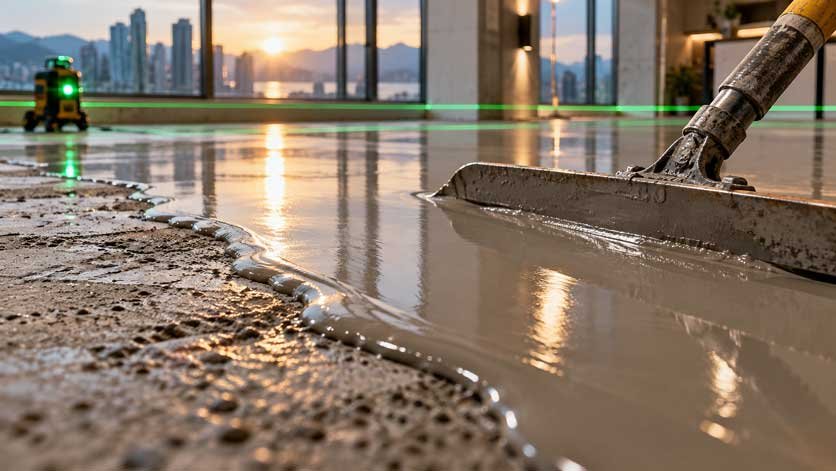
Here is an industry secret that many generic contractors won't tell you: The best acoustic underlayment in the world cannot fix an uneven subfloor.
If your concrete slab has a dip in it, and we lay rubber underlayment and hardwood over it, there will be a hollow gap underneath. Every time you step on that spot, the floor will hit the concrete and make a loud "clack." Not only is this annoying, but your downstairs neighbor will hear it, complain, and the strata could force you to rip the floor up.
At Elite Flooring Ltd., subfloor preparation is our obsession.
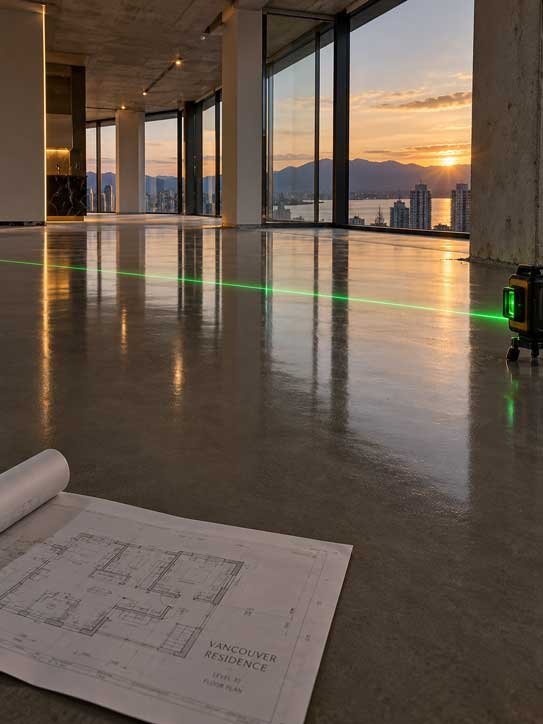
Before a single piece of underlayment goes down, we laser-measure your concrete slab. We grind down high spots and pour premium self-leveling compounds into the low spots. A perfectly flat subfloor ensures that the acoustic underlayment works exactly as it was tested in the lab, guaranteeing a silent, solid, and luxurious feel underfoot.
Ready to Upgrade Your Condo Floors the Right Way?
Navigating Vancouver's strata flooring bylaws can feel like a legal maze, but you don't have to do it alone. The risk of buying unapproved materials or facing strata fines is too high to leave to chance.
At Elite Flooring Ltd., we handle the technical headaches for you. From selecting the perfect engineered hardwood or waterproof LVP to providing the exact acoustic data sheets your property manager demands, we ensure your project is approved seamlessly and installed flawlessly.
Protect your investment, respect your neighbors, and elevate your living space.
